

Digital Products Using Connected Products (2)Use of Product Operation Data to Promote Recurring Business and Measures for Behavior ChangeTalkative Products Using Predictive Diagnosis and Generative AI
Highlight
Issues such as the shrinking workforce and environment problems have directed attention in recent years toward the use of data from industrial equipment collected via the IoT for labor-saving measures and to improve operational and energy efficiency. In response, Hitachi Industrial Equipment Systems Co., Ltd. has developed a predictive diagnosis service that uses AI and generative AI to process big data. It is also conducting functional trials to facilitate its consulting business.
This article describes the Talkative Products system, which uses AI and generative AI techniques for the predictive diagnosis of abnormalities in the discharge temperature of air compressors, the provision of new value to customers who have purchased equipment, and the development of new services. It also presents the work being done to ensure reliable and efficient product operation, using operational data collected from equipment to encourage recurring business and to facilitate behavior change by customers and other product stakeholders.
1. Introduction
The shrinking workforce and action to address environmental problems have become urgent issues over recent years. In the industrial equipment sector, this is driving demand for labor-saving measures and improvements in operational and energy efficiency achieved by putting the data acquired by Internet of Things (IoT) technologies to use.
Having developed technology to address these challenges in the form of predictive diagnosis using big data and a predictive diagnosis service that uses artificial intelligence (AI) and generative AI, Hitachi is conducting functional trials to facilitate its consulting business. Not only do these technologies improve the operational efficiency of industrial equipment, but they also have the potential to reduce the load on the environment.
This article presents an example data application using the FitLive equipment monitoring service from Hitachi Industrial Equipment Systems Co., Ltd. (HIES) to give an overview of predictive diagnosis and a function planned for the future called Talkative Products.
2. Issues for the Maintenance of Industrial Equipment
Figure 1—Overview of FitLive Equipment Monitoring Service and Contact Service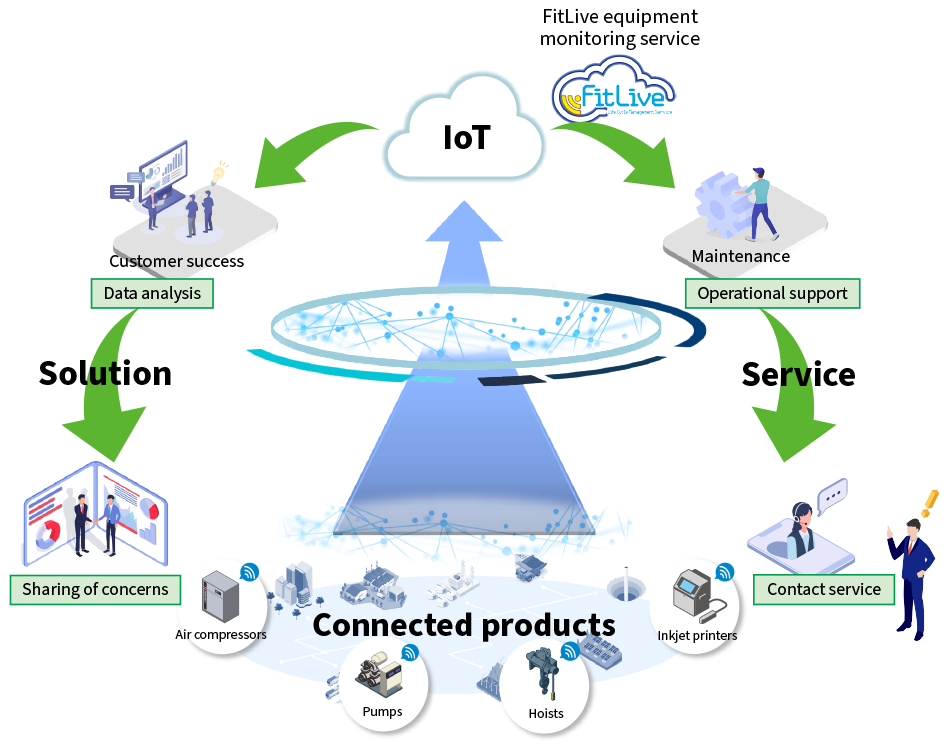 IoT: Internet of ThingsThe figure gives an overview of the contact service, which uses data from the FitLive monitoring service for industrial equipment to deliver value to customers. Through the analysis of operational data sent to FitLive, the service helps to keep industrial equipment at peak performance, including equipment upgrades and energy efficiency improvements as well as by performing predictive diagnosis before problems arise and providing timely maintenance support.
While equipment administrators and specialist technicians who conduct periodic maintenance inspections are required to keep industrial equipment operating reliably, factors such as the aging of the population are causing the workforce to shrink year by year, creating an urgent need for remote maintenance management and improved operational efficiency. The need to prevent global warming means that there is also growing demand for reducing power consumption and for operating equipment and machinery more efficiently to reduce the load on the environment. It was against this background that, in 2017, HIES commenced supply of connected products that incorporate IoT support as a standard feature. The FitLive equipment monitoring service has been supplied to numerous corporate customers in the manufacturing and other industries and features a high equipment connection percentage*. The company went on to launch a contact service in 2021 that uses data on equipment operation, including abnormalities and faults, to indicate to customers when to perform maintenance and to suggest ways of improving energy efficiency or to notify them of equipment upgrades (see Figure 1).
- *
- Connected machines as a percentage of all machines shipped. While customers are free to disconnect the communication function, 70 to 80% of all customers agree to transmit data to FitLive.
However, as the number of suggestions increased in proportion to the number of machines connected to FitLive, there was a limit on how many suggestions could be handled and decided on manually. Accordingly, Hitachi is working on the development of Talkative Products, which, instead of issuing notifications after equipment condition has deteriorated, works by first using predictive diagnosis to identify signs of potential deterioration and then using generative AI to inform customers of the diagnosis results. In addition to reducing downtime and maintenance work, Hitachi also aims to improve product efficiency and maintain reliable operation by interacting with customers via their equipment and using this as an opportunity to encourage behavior change by customers and other product stakeholders.
3. Development of AI-based Predictive Diagnosis Service
Figure 2—How Predictive Diagnosis is Used for to Propose Reactive and Preventive Maintenance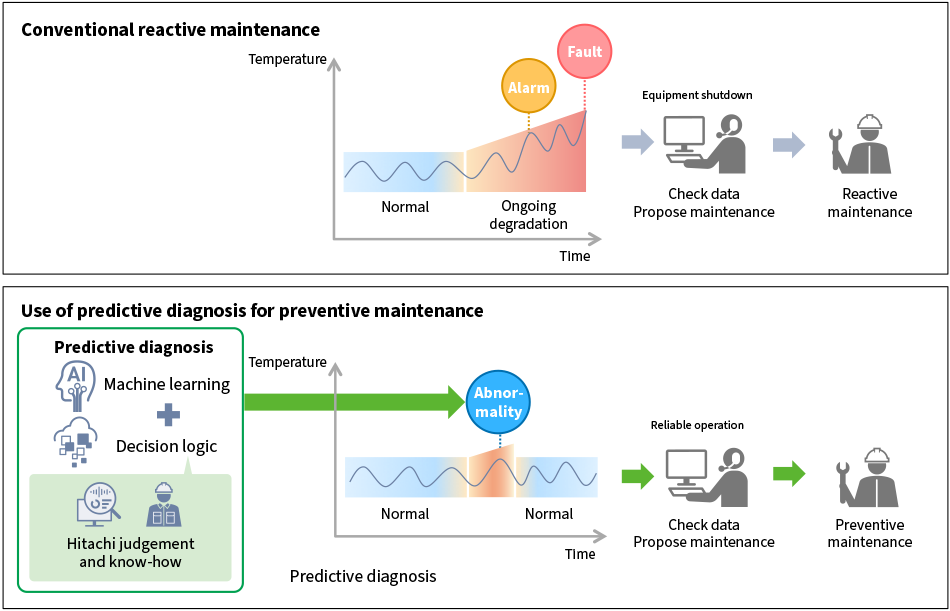 AI: artificial intelligenceThe diagram shows how machine learning is used to provide predictive diagnosis for air compressors. By using operating data for machine learning, this function can identify signs of potential faults before they occur based on equipment condition. The function was then transformed into a practical product by incorporating decision logic derived from the know-how of Hitachi maintenance personnel to improve its accuracy.
HIES equipped its air compressors with IoT support as a standard feature in 2017. An analysis of operational data collected from this equipment indicated that about 75% of abnormalities and faults are temperature-related. This suggested that product reliability could be further improved by identifying temperature rises before an abnormality or fault occurs. Accordingly, a predictive diagnosis service was developed that uses machine learning to prevent problems before they manifest through the comprehensive analysis of time-series data collected from sensors and its use as a basis for taking action.
Predictive diagnosis combines a machine learning algorithm for temperature prediction with rule-based decision logic. Moreover, the accuracy of machine learning was enhanced by taking advantage of the large number of IoT-connected machines to accumulate data. HIES also formalized know-how that its maintenance staff had accumulated in their maintenance administration work and utilized it as a resource for decision-making. The rules that formalize this know-how were formulated by having data scientists ask maintenance personnel about what they knew. The results of applying these rules to data were then reviewed with the maintenance personnel. By repeatedly working through this process, the decision logic was established. This logic, by combining a machine learning model trained on a large quantity of data with the domain knowledge of maintenance personnel, enabled Hitachi to successfully create a predictive diagnosis function with a high level of accuracy (see Figure 2).
While the function is currently only being used on the NEXT III series of oil-flooded rotary screw compressors (inverter-driven with a rated output of 22 or 37 kW), Hitachi intends to expand its scope to other products in the future. By further developing this service, Hitachi should be able to offer faster and more fine-grained preventive maintenance and to advise on how to operate air compressors in ways that cut power consumption and reduce the load on the environment while also minimizing outages.
4. Development of Talkative Products Featuring Generative AI
This section goes into detail about Talkative Products. This service can interact with people by generating text, using background knowledge from sources that include relevant documentation, operational data, and the results of predictive diagnosis as input to a generative AI. This involves initially training the AI on product manuals using retrieval-augmented generation (RAG). RAG is a commonly used technique for augmenting the response performance of generative AI by including an ability to access external information. Next, sensor readings and other operational data collected via the IoT and the output of the predictive diagnosis AI are converted to text using a rules-based process and this text is added to the input prompt for the generative AI. To boost user engagement with the product, the prompt is also augmented with additional information that will cause it to generate a more human-friendly response. The result of this work was Talkative Products, which features interactive capabilities and generative AI using a variety of information about the product (see Figure 3).
One of the challenges that arise when seeking to use generative AI in manufacturing is how to develop techniques for manipulating complex knowledge with high accuracy. For example, product manuals, which contain operating procedures full of instructions in text-format and if-then branches. Unfortunately, using these as input to generative AI results in poor quality responses to queries. Instead, prior to input to the generative AI, the text is first transformed into structured data using formats such as tables, structured query language (SQL), and flowcharts, etc. This improves response performance as structured data is easier for generative AI to interpret. This was done for Talkative Products after first confirming that it improved response performance (see Figure 4). The technique used for this purpose was developed jointly by HIES and the Connected Drive System Research Department at the Research & Development Group of Hitachi, Ltd.
It is anticipated that Talkative Products will encourage recurring business and facilitate behavior change by customers and other product stakeholders. By anthropomorphizing products and having them take the initiative in interacting with stakeholders, the goal is to raise user awareness and engagement with products while also making them more reliable and efficient.
Figure 3—Block Diagram of Talkative Products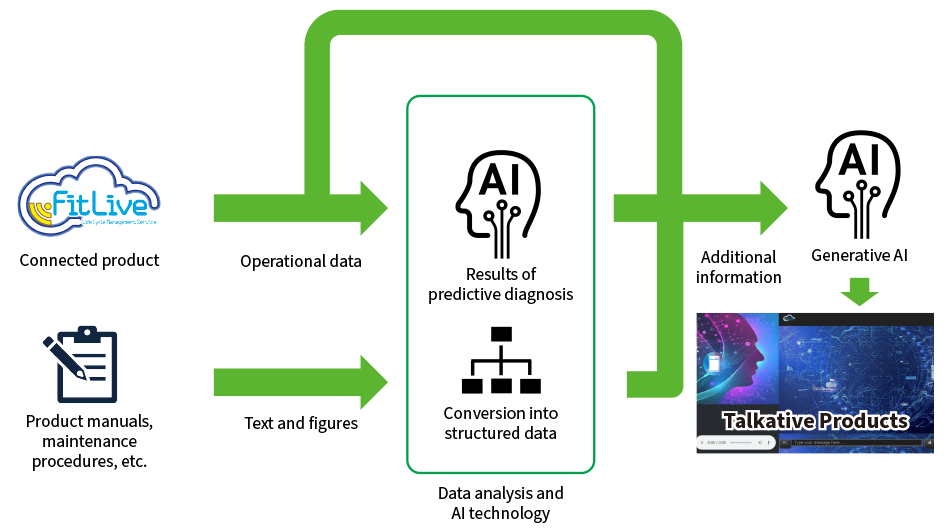 The additional input information used by the generative AI to produce its response includes, (1) data on product operation collected via the IoT, (2) predictive diagnosis and other results generated by the AI processing of operational data, and (3) data from product manuals made easy for generative AI to interpret through the use of tools for producing structured data.
Figure 4—Generation in Talkative Products of Structured Data with Understanding of Manufacturing Expertise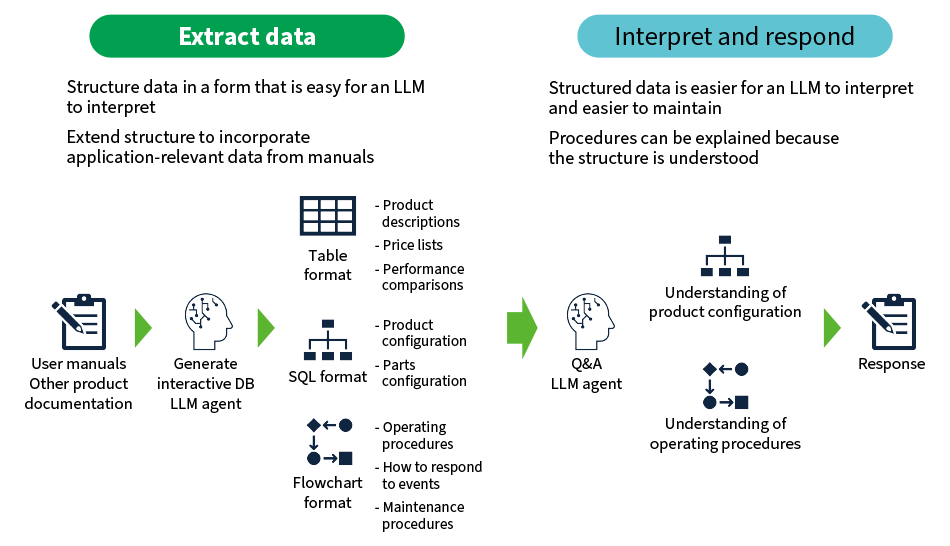 LLM: large language model, DB: database, SQL: structured query languageResponse performance is improved by converting text data containing complex procedures, if-then branches, and structured formats into structured data formats such as tables, SQL, and flowcharts and using it as input to an LLM. LLMs are the technology that underlie generative AIs with natural language capabilities.
5. Conclusions
This article has described the features of a predictive diagnosis function and the Talkative Products service. The predictive diagnosis function incorporates an AI developed using operating data from the FitLive equipment monitoring service whereas Talkative Products is based on the use of generative AI.
The predictive diagnosis system can improve operational efficiency by preventing faults before they occur, thereby reducing both downtime and maintenance work. The generative AI of Talkative Products, meanwhile, has the potential to enhance product value while also helping users to operate products more efficiently. In the future, Hitachi aims to increase recurring business by deploying these technologies as added-value features in connected products while also helping to improve customer work efficiency, resolve environmental challenges, and address the challenges facing frontline workers in the industrial equipment sector.