

Hitachi’s Efforts in the Nuclear Sector (4)Injection of Noble Metal to Prevent SCC in Reactor Internal Structures
Highlight
If nuclear energy is to provide around 20% of Japan’s electricity generation in 2040 to help achieve carbon neutrality, the operating life of existing nuclear power plants will need to be extended and their capacity factor improved. One of the concerns associated with this is the stress corrosion cracking (SCC) of the reactor internals. Ensuring the reliable long-term operation of nuclear power plants with the maintenance of high rates of plant utilization will require monitoring for signs of SCC and the appropriate preparations to be put in place to address any SCCs identified. In doing so, it makes sense to learn from the USA, which already has experience with extended plant operating lives. On-Line NobleChem (OLNC), a technique for injecting noble metal, inhibits the progression of SCC by utilizing the catalytic properties of noble metals to reduce the corrosion potential on material surfaces while operating with a low level of hydrogen injection. In addition to developing an iron/iron-oxide sensor (Fe-type sensor) and other techniques for enabling the measurement of corrosion potential as an indicator of how well OLNC is working, Hitachi GE Vernova Nuclear Energy, Ltd. has also been studying the side effects of the technique when deployed in Japanese plants.
This article summarizes OLNC and how it inhibits SCC, describes how the technique has performed in the USA and the other new technologies developed for its use, and considers the outlook for the future.
1. Introduction
Japan’s Seventh Strategic Energy Plan1) indicates that nuclear energy is to provide around 20% of electricity generation in 2040 to help achieve carbon neutrality. This will require that the operating life of existing nuclear power plants be extended and their capacity factor improved. One of the concerns associated with this scenario is the stress corrosion cracking (SCC) in the structural materials of reactors2). Common practices adopted in the past to address SCC have included the use of corrosion-resistant materials and techniques such as water jet peening (WJP) for improving residual stresses. At boiling water reactors (BWRs) in the USA, however, the injection of hydrogen and noble metals into reactor water to alleviate the corrosive environment, known as On-Line NobleChem* (OLNC), has successfully suppressed the initiation and propagation of SCC in reactor internals3). It is hoped that the safety of BWRs in Japan can likewise be improved by adopting the technique.
This article summarizes OLNC and its central role as an environmental mitigation technique for inhibiting SCC, also describing how the technique has performed in the USA, the other new technologies developed for its use, and the outlook for the future.
- *
- On-Line NobleChem is a trademark of General Electric Company.
2. OLNC for Inhibiting SCC
It is known that SCC can be prevented by keeping the electrochemical corrosion potential (ECP) of stainless steel below -230 mV relative to the standard hydrogen electrode (SHE)4). While hydrogen injection has been used in BWRs since 1979, keeping the ECP of reactor internals below the target requires that the feedwater have a hydrogen concentration of more than 1 ppm (see Figure 1). While injecting hydrogen at high concentrations keeps the ECP low, it also changes the chemical form of the 16N formed in the reactor by irradiation and increases the fraction present in the main steam feed. This has the side effect of making the turbine more radioactive, thereby increasing exposure for operators performing inspections5). If instead a noble metal is injected into the reactor so that it adheres to the surface of structural materials, its catalytic properties will efficiently reduce the ECP even with a low concentration of hydrogen in the feedwater of about 0.2 to 0.3 ppm. As the increase in turbine radioactivity is negligible for hydrogen concentrations below 0.5 ppm in the feedwater, this overcomes the above problem of increased radiation exposure. That is, use of OLNC makes it possible to inhibit SCC without any major side effects. The following sections summarize how the injection of noble metal works and describe the associated technology developments.
Figure 1—Differences in Corrosion Potential Reduction Behavior for Hydrogen Injection and Noble Metal Injection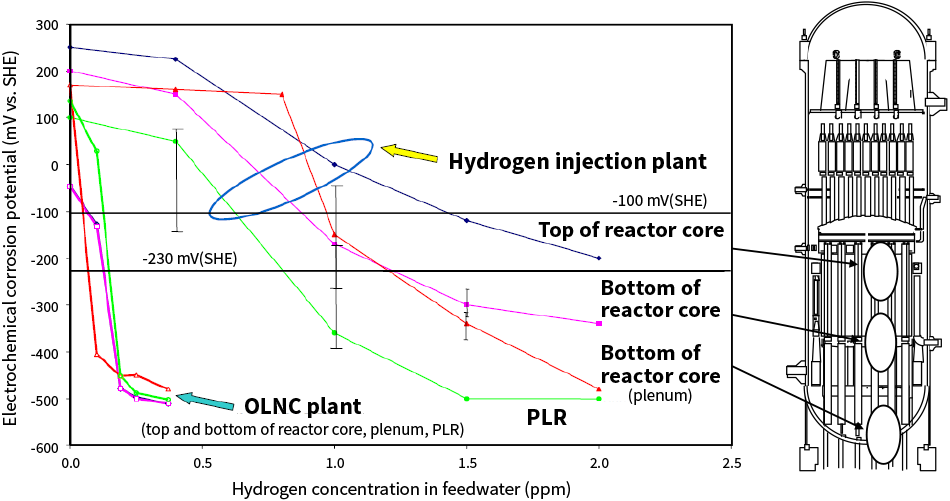 PLR: primary loop recirculation system, SHE: standard hydrogen electrode, OLNC: On-Line NobleChemAchieving the corrosion potential of -230 mV vs. SHE assumed necessary for inhibiting SCC by means of hydrogen injection requires increasing the amount of hydrogen injected via the feedwater. In contrast, use of noble metal injection can significantly reduce the amount of hydrogen injection needed.
2.1 Overview of OLNC
Noble metal injection was first used in US plants in 1996. While the initial practice was to inject aqueous solutions containing platinum (Pt) and rhodium (Rh) during plant shutdowns, this was changed to OLNC in 2006 to avoid the loss of plant utilization that resulted from the two days or so needed for the injection work. OLNC works by injecting an aqueous solution that contains Pt only and can be performed when the plant is operating at its rated output. Most US plants currently use OLNC5).
Figure 2 shows the system configuration for using OLNC. With OLNC, the injected Pt solution is diluted with purified make-up water (MUWP) from the feedwater. A mitigation monitoring system (MMS) is also installed in the clean-up water (CUW) system to determine how much of the injected Pt has been deposited and the extent to which the ECP has been reduced. Similarly, an inductively coupled plasma mass spectrometer (ICP-MS) is used to make highly sensitive measurements of the concentration of Pt in the reactor water during application.
Limits are also placed on when OLNC injection can be performed. This is done to maintain fuel integrity when newly loaded and to reduce exposure during routine inspections. That is, to get the Pt to adhere to the surface of structural materials, the Pt aqueous solution is injected over an approximate two-week period at roughly one-yearly intervals, and this is done from two months after plant operation starts until three months prior to the next shutdown. Reactions catalyzed by the Pt deposited on surfaces promote the recombination of oxygen and hydrogen in the cooling water. Provided that the hydrogen/oxygen (H/O) mol concentration ratio remains above 2, the conditions in the water should keep the corrosion potential at material surfaces close to the theoretical potential of Pt (approximately −500 mV vs. SHE), which is below the -230 mV vs. SHE threshold at which SCC should be inhibited.
Figure 2—System Configuration when Using OLNC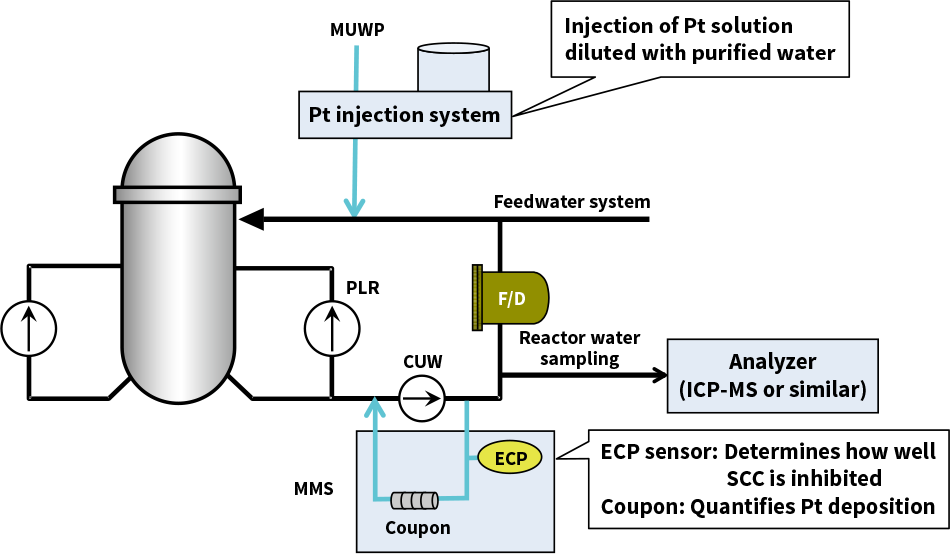 MUWP: make-up water (purified), F/D: filter/demineralizer, CUW: clean-up water system, ICP-MS: inductively coupled plasma mass spectrometer, MMS: mitigation monitoring system, ECP: electrochemical corrosion potential, SCC: stress corrosion crackingAdoption of OLNC also involves the use of equipment such as the Pt injection system, the MMS for quantifying Pt deposition amount and the reduction in ECP, and an ICP-MS for measuring the very low levels of Pt present during application.
2.2 Technology Development for Installation in Japan
Although OLNC is widely used in the USA, issues remain with the technology. These include the problem of differential pressure increase in the injection line during application, flow-accelerated corrosion (FAC) in the CUW pipes, and how to extend the life of ECP sensors. The following sections describe the work undertaken by Hitachi GE Vernova Nuclear Energy, Ltd. to address these issues.
- Dealing with differential pressure rise in the injection line
Figure 3—Reduction in Pt Deposits from Switching to Pt Nanoparticles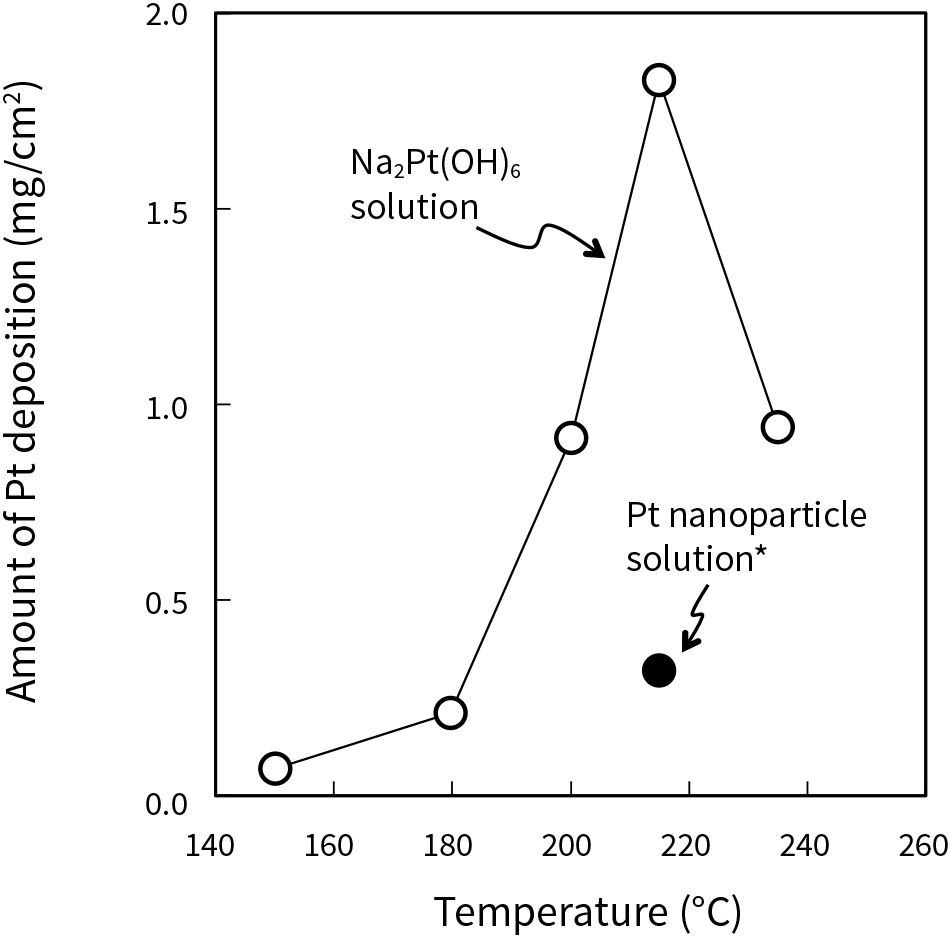 * As the Pt concentration is different, the amount of Pt deposition was increased by a factor of 1.25 to compensate.The results show that Pt deposition when using Pt nanoparticles is only one-fifth as much as for the Na2Pt(OH)6 solution that is currently used.
As shown in Figure 2, Pt is injected into the feedwater in the form of a sodium hexahydroxyplatinate solution [Na2Pt(OH)6]. Once injected, the Pt precipitates onto pipe surfaces due to reduction reactions with the hydrogen present in the feedwater and thermal decomposition under the high-temperature conditions. However, there have been cases where pipes have become constricted due to the build-up of these Pt deposits, resulting in an increase in differential pressures and ultimately in the pipes becoming blocked. A degree of success at minimizing this effect has been achieved by increasing the rate of dilution with purified water in the injected solution, thereby decreasing the concentration of Pt and reducing precipitation. To further improve performance at minimizing the differential pressure rise, Hitachi GE Vernova Nuclear Energy has developed Pt nanoparticles for use as the Pt injection additive that are less likely to adhere to the inner surfaces of pipes. To produce these Pt nanoparticles, the Na2Pt(OH)6 currently used as the additive is used as a feedstock. After first using an ion exchange membrane to reduce the amount of Na (a cause of variation in reactor water quality), the nanoparticles are formed by exposure to γ radiation. As the resulting additive has only about one-fifth as much Na as the current solution, it should reduce the variability of the electrical conductivity and pH of the reactor water during application for a given Pt injection rate (g-Pt/h). Moreover, laboratory testing has demonstrated that the amount of material deposited on pipes when using Pt nanoparticles is only one-fifth as much as for the currently used solution (see Figure 3), and the diameter of deposited particles is also similar to when using the current solution6).
- Preventing FAC in CUW pipes
Figure 4—Relationship between FAC and ECP at 280°C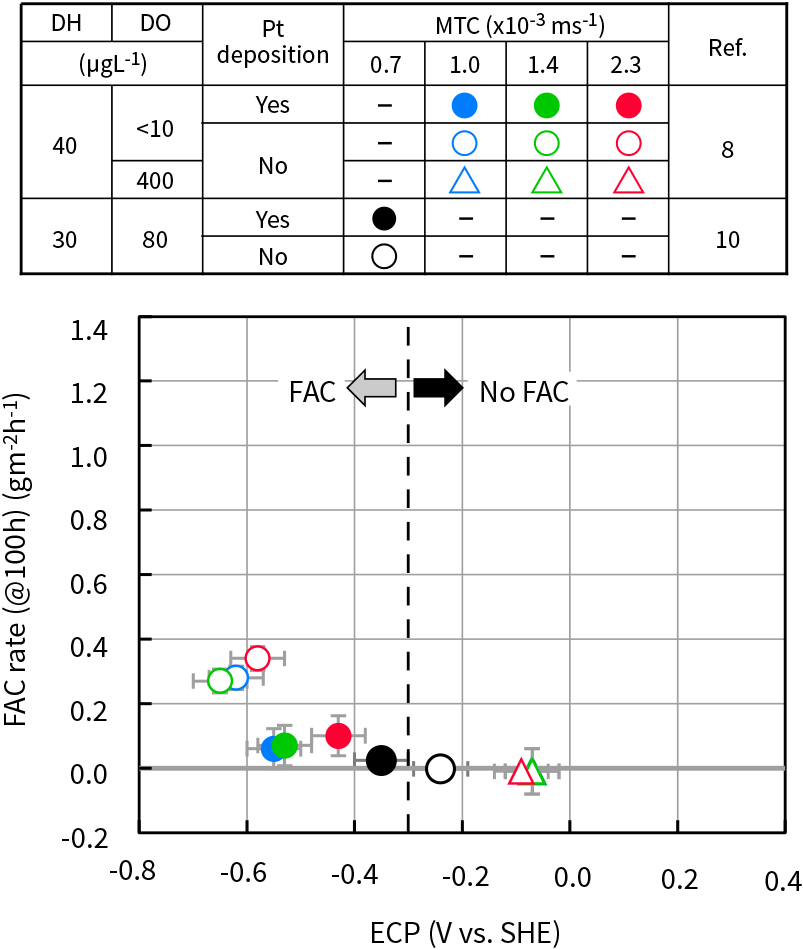 FAC: flow-accelerated corrosion, DH: dissolved hydrogen, DO: dissolved oxygen, MTC: mass transfer coefficientWhen data on ECP was collated for different values of dissolved hydrogen (DH) concentration, dissolved oxygen (DO) concentration, and mass transfer coefficient, it was found that a threshold of -0.3 V vs. SHE could be used as a criterion for whether FAC will occur.
At US plants that have used environmental mitigation techniques to operate under conditions in which the concentration of dissolved oxygen (DO) in the reactor water is maintained below 15 ppb, instances of FAC have been reported in the carbon steel pipes that form part of the CUW system for reactor water purification7). A major cause of FAC is when low levels of oxygen in the water inhibit the formation of corrosion-resistant oxide films on the surface of carbon steel pipes. Analysis of the distribution of DO concentrations in the CUW system when noble metal injection is used has found that cooling water in the first stage of the CUW regenerative heat exchanger has concentrations that are lower than the threshold below which FAC occurs. This indicates an elevated risk of FAC in heat exchanger connecting pipes that are at temperatures close to 150°C where the rate of material erosion due to FAC is highest. It was also concluded that tracking ECP is also a useful indicator for monitoring FAC when noble metal injection is used as, in addition to the DO concentration, the concentration of dissolved hydrogen (DH) in the cooling water also influences FAC in the CUW system when Pt has been deposited (see Figure 4)8 - 10). The consequences for FAC of Pt deposition and using zinc (Zn) injection to reduce radiation exposure was also evaluated and it was found that the presence of Zn in low concentrations of around 10 ppb reduces the rate of FAC by about half.
- ECP sensor development
ECP is measured to provide an indication of how well environmental mitigation is working, including at plants in Japan that use hydrogen injection. While a variety of different types of sensors can be used to measure ECP, each has its own advantages and disadvantages. In practice, Pt sensors, iron/iron-oxide sensors (Fe sensors), and stainless steel (SS) sensors are used in tandem (see Table 1). While Pt sensors have a comparatively long life and provide reliable readings when the H/O mol ratio of hydrogen and oxygen is 2 or higher, they do not provide correct values when the H/O mol ratio is below 2. With Fe sensors, meanwhile, although they provide accurate measurements regardless of the H/O mol ratio, they suffer from a comparatively short sensor life. When noble metal injection is used, SS sensors show the same ECP as Pt sensors and there is no way of telling whether a SS sensor has failed when used in tandem with a Pt sensor. Hitachi GE Vernova Nuclear Energy has been working on improving the life of Fe sensors, successfully developing a sensor with an expected life of four years or more in an operating plant based on benchmark testing conducted under accelerated conditions at the US Electric Power Research Institute11). While ECP measurement in the past has been performed at the reactor water temperature of 288°C found in plants operating at rated output, there is also work on the development of zirconium (Zr) sensors and the potential for expanding the use of Fe sensors to meet the emerging demand for measurement at temperatures of between 150°C and 200°C that occur in the CUW system or during reactor startup.
Table 1—Pros and Cons of Different ECP Sensors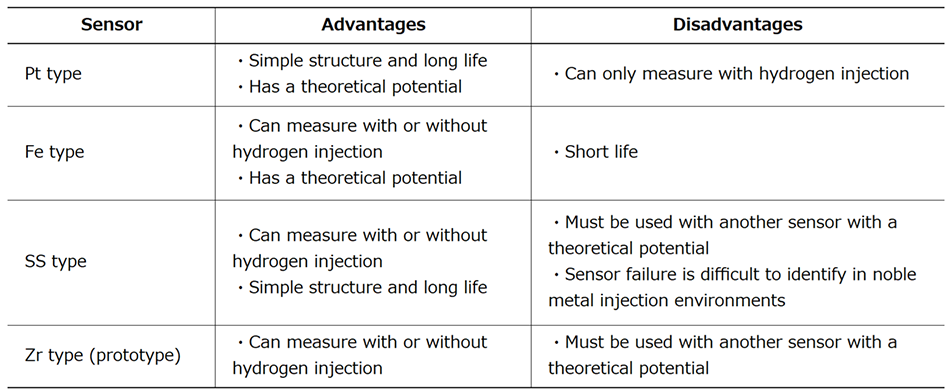 SS: stainless steelWhile a variety of different ECP sensors exist, each has its own advantages and disadvantages. Recommended practice is to use a number of different sensors to provide redundancy.
3. Conclusions
OLNC inhibits SCC of reactor internals by mitigating the corrosive environment. At BWR plants in the USA, it is also helping to improve plant utilization in addition to enhancing the reliability of reactor structures. For BWR plants in Japan, meanwhile, the goals are to get plants restarted and then to keep them running for long periods with high utilization. Here, the use of OLNC is seen as desirable both to further improve nuclear power plant safety and to contribute to achieving carbon neutrality. Having analyzed how OLNC has performed in the USA and the issues it has raised, Hitachi GE Vernova Nuclear Energy has been supporting the smooth introduction of the technology into nuclear power plants in Japan. This has included the development of Pt nanoparticles as a measure for minimizing the differential pressure rise in injection lines, a technique for assessing FAC in CUW pipes when environmental mitigation measures are in use, and long-life ECP sensors that will be essential for assessing how well environmental mitigation is working.
REFERENCES
- 1)
- Agency for Natural Resources and Energy, Ministry of Economy, Trade and Industry, “Seventh Strategic Energy Plan” (Feb. 2025) in Japanese.
- 2)
- Nuclear and Industrial Safety Agency, “Summary of Knowledge to Date on Stress Corrosion Cracking (SCC),” (Jul. 2006) in Japanese.
- 3)
- S. Hettiarachchi et.al., “Water Chemistry Improvements in an Operating Boiling Water Reactor (BWR) and Associated Benefits”, NPC2010, Quebec(2010)
- 4)
- R. L. Cowan et al., “Experience with hydrogen water chemistry in boiling water reactors”, Water Chemistry for Nuclear reactor systems 4. BNES, London(1986)
- 5)
- S. Garcia et al., “Advancements in BWR IGSCC Mitigation Guidance with Noble Metal Chemistry”, Proc. of NPC2018(2018)
- 6)
- K. Ishida, et al., “Formation of platinum nanoparticle colloidal solution by gamma-ray irradiation, J. of Nucl. Sci. and Technol., Vol. 54, No. 3, pp356-364(2017)
- 7)
- S. Garcia, “Impact of BWR IGSCC Mitigation Strategies on FAC in Carbon Steel RWCU Systems”, Proc. of NPC2018(2018)
- 8)
- Wada Y. et al., “Effects of Pt deposition on flow accelerated corrosion of carbon steel under simulated reactor water cleanup system conditions (1) - effects of platinum on FAC rates at 423 K and 553 K in hydrogenated and oxygenated environments”, JNST, Published online(2025.3)
- 9)
- H. Murotani, et al., “Effects of Oxygen Injection and Platinum Deposition on Flow Accelerated Corrosion of Carbon Steel under Simulated Reactor Water Clean-up System Conditions: (2) Effectiveness of Oxygen Injection on FAC Mitigation at 150°C,” Proceedings of the Atomic Energy Society of Japan 2024 Spring Meeting 1M03 (2024) in Japanese.
- 10)
- Y. Wada, “Effects of Oxygen Injection and Platinum Deposition on Flow Accelerated Corrosion of Carbon Steel under Simulated Reactor Water Clean-up System Conditions: (3) FAC rates of carbon steel at 280 °C with Pt,” Proceedings of the Atomic Energy Society of Japan 2024 Fall Meeting 1M06 (2024) in Japanese.
- 11)
- EPRI, “Program on Technology Innovation: Durability Testing of Improved Zr-Membrane and New Type Zr-Metal Reference Electrodes”, PID 3002026616(2024)